

Reviews
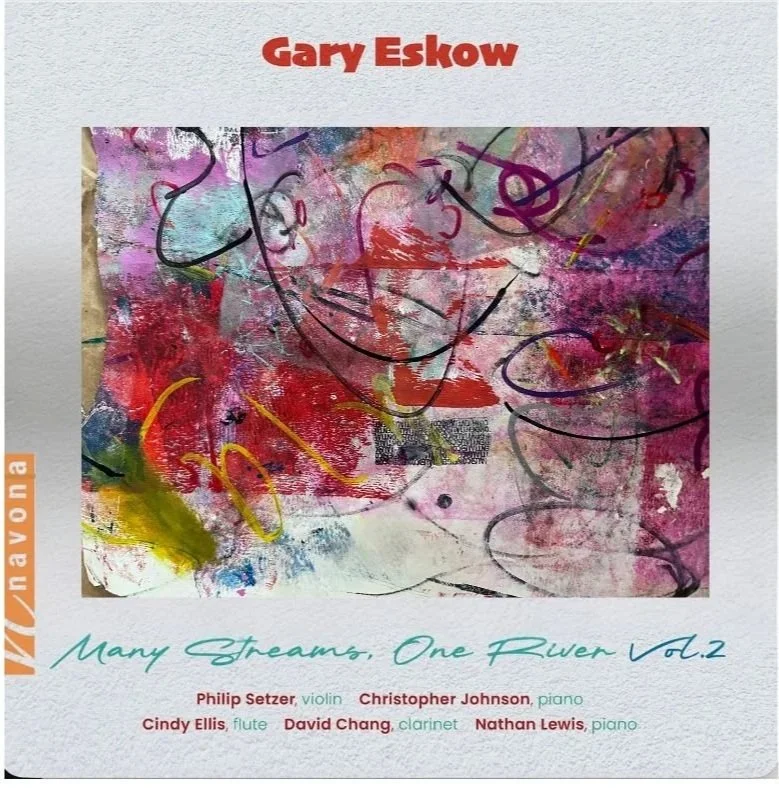
Many Streams, One River (Volume 2)
I gave a warm welcome to the predecessor volume in this series (3/26), with its endearingly quirky inspirations of pieces, and this second album follows in a similar vein. Gary Eskow’s engaging suite Storms Will Come (2023‑24) was written at the request of Philip Setzer, founding violinist of the Emerson Quartet, on his retirement – and he is the elegant performer here, accompanied by Christopher Johnson, the sole returnee from Vol 1 – but it is the subtitle, ‘as if an LP from 1969’, that gives the clue to the disposition of the eight very varied miniatures into two groups, ‘Side A’ and ‘Side B’!
Eskow’s whimsical humour is more overt this time around, for instance in the wrong-footing ‘Scherzophrenia’ finale of Not a Sonata! (2008, rev 2023). A largely gentle, jazzy trio for flute, clarinet and piano, this set of tributes to favourite composers or musical genres spotlights respectively Poulenc (and his Oboe Sonata), the then recently deceased Ray Charles and Hollywood cinematic Romanticism (‘Coconut Cream’), while in ‘Scherzophrenia’, as the composer wryly comments, ‘I grabbed a hammer and had some fun fracturing Baroque contrapuntal textures’.
Eskow’s eclecticism shines through in Storms Will Come and also Channeling Chopin (2025), in which latter a 1962 pop song from a TV show sits athwart a gentle piano homage to the Polish master. There are homages in Eskow’s brief first piano sonata (2024, rev 2025), too, the third span honouring the Henry Mancini of Breakfast at Tiffany’s (rather than The Pink Panther), and the sonata as a whole, titled Sunlight, indirectly evokes Beethoven, though there all comparisons end. The most characterful of the piano pieces is The Woodstock Chronicles (2017–21, rev 2025), a suite of four pieces inspired by the composer’s move from New Jersey to Woodstock (yes, that Woodstock), in upstate NY. Once again, it proves a very diverse group of pieces – heard with the innocent ear, no less sonata-like than the other works here – convincingly performed by Nathan Lewis. As with Vol 1, the final track crosses genres: here a brief, rejected jingle for a delivery company. Roll on Vol 3.
Guy Rickards, Gramophone Magazine
August 2026
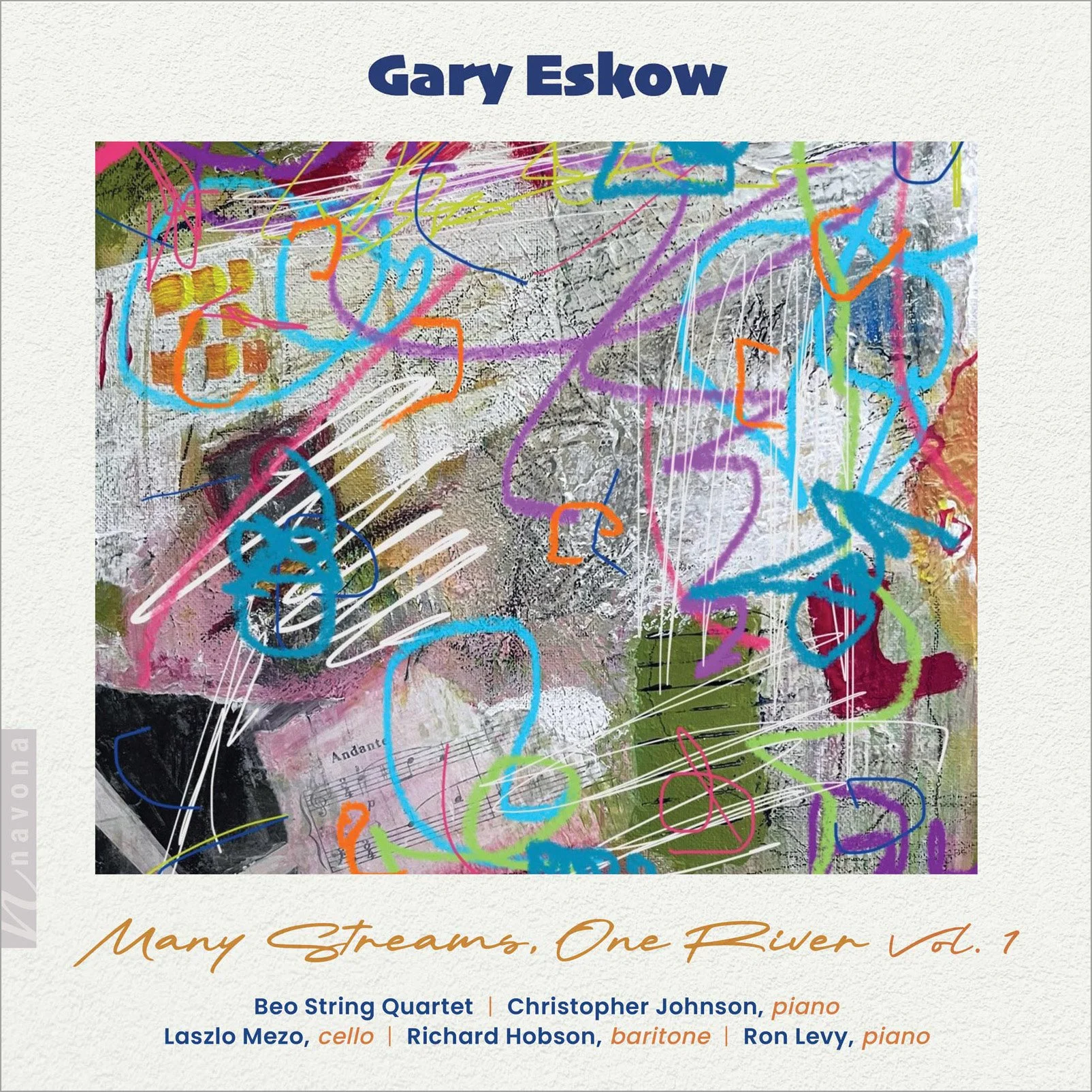
Many Streams, One River (Volume 1)
Gary Eskow (b1951) was a new name when I chanced upon this album released by Navona late last year. Many composers combine their activities with other careers (not always within music), whether academic, performing or writing; Eskow does some writing on music but first and foremost describes himself as ‘a fan’, and there is something of an engaging sense of discovery in all the works collected here, several (but not all – dates for most are not provided) of recent provenance.
A fine example of that – and, to my ears, the finest music featured – is the string quartet Remo’s Revenge (2013 or thereabouts). This work came about after Eskow had sought out and talked music with the excellent American composer Fred Lerdahl – ‘one of America’s great secret treasures’ in Jed Distler’s opinion (I do not disagree) – whose music Bridge Records has championed frequently (2/12US, 11/17US, 6/24). Eskow was fired by that conversation to compose this quartet though it quickly, and compellingly, moves off in its own direction and is splendidly performed by the Beo Quartet. The aphoristic piano suite The Gallery Wall (c2018) is a set of brief reflections on music, delicately played by Christopher Johnson, by other composers Eskow has studied.
Johnson is the accompanist to László Mezo˝ in the cello-and-piano suite Undertow, which also starts with a (slightly ponderous) tribute piece, to the jazz pianist Bill Evans. The suite takes off, however, in the second movement, ‘Steps of the Alhambra’, a reimagining of Tárrega’s Recuerdos de la Alhambra. Bach and Eric Clapton hover behind the remaining two movements.
The song set Dispatch from the Killing Floor (2000 01) is the gravest item featured, arising from a composition exercise set by Richard Danielpour, in which – as in the wind trio Microscope (1995) – one senses Eskow still feeling his way. Neither piece quite catches the assurance of the cabaret song ‘Lillet Aperitif’, composed for the late Liliane Montevecchi (1932-2018), or the piano set (Christopher Johnson again) Two Blues and a Berceuse. This is an entertaining portrait album of a little-known composer who knows what he is doing.
Guy Rickards, Gramophone Magazine
February 2026
Interviews
Composers Perry Goldstein & Gary Eskow
on what makes music American
MANCHESTER - As the Manchester Music Festival explores its 2026 theme, "Sounding America," two composers are helping audiences hear the question at its center: What does American music actually sound like?
Perry Goldstein, a composer who has taught at Stony Brook University for more than three decades, returns to the festival to lead a pair of "Inside the Music" pre-concert talks, including one on Wednesday, July 29. The following evening, Thursday, July 30, the festival will present the first public performance of "Storms Will Come," a suite by Gary Eskow written for Festival Artistic Director Philip Setzer.
The two composers, who spoke together on a recent Zoom call, could hardly have arrived at the festival by more different routes: one through the academy, one through the world of Madison Avenue jingles, and their conversation ranged from William Billings to Ronnie Milsap, from Amy Beach to Earl "the Pearl" Monroe.
-
Goldstein first came to Manchester last season, when the festival performed his song collection Birding by Ear, a collaboration with his longtime friend Richard Powers, the Pulitzer Prize-winning author of The Overstory.
"I was really pleasantly surprised at how receptive the audience was," Goldstein recalled. The performance itself, featuring baritone Randall Scarlata and pianist Gilles Vonsattel, delighted him. "It doesn't get better than that."
The experience convinced him of something about Manchester audiences.
"I think the festival programs these things with attention to expanding the audience's aesthetic vocabulary," he said. "I think we all felt so positively last year about that piece expanding it." This summer, he's back at the festival's invitation to illuminate the repertoire from the stage.
Aunt Sarah and the American sound
Ask Goldstein about American music and you get a story that begins with William Billings, the fiercely independent early American composer who died in 1800.
"Rough-hewn music," Goldstein said, full of the parallel fifths that music theory teachers forbid. "The music is wild."
Then, in the 19th century, something shifted.
"American composers had what I would call an inferiority complex," he said, noting that even the founders aspired to European culture: George Washington owned Mozart's music, and Thomas Jefferson met Mozart in Paris. He likely would have commissioned him to write a piece had he not found him "so socially uncouth and frivolous." Late nineteenth-century composers like Horatio Parker, Edward MacDowell, and Amy Beach wrote music in a European mold.
It took Parker's own student, Charles Ives, to declare independence. Goldstein paraphrased Ives' famous credo: that American music should aspire to the condition of old Aunt Sarah, who after working a 14-hour day caring for her ailing brother's children, still hitched up the wagon to drive through the mud and rain to prayer service, where she could give full expression to the fullness of her unselfish soul. If American composers could, according to Ives, "reflect the fervency of such a spirit, he may find there a local color that will do all the world good."
That tension animates the programs he'll be discussing: music written in the European tradition alongside the assertion of an American voice that begins with Scott Joplin's rags in the 1890s and blossoms in composers like Duke Ellington, Leonard Bernstein, and John Williams.
"They're saying, how can our music reflect the spirit of America?" Goldstein said.
Audiences will also hear the Hollywood side of the story, including Bernard Herrmann's Souvenirs de Voyage, a clarinet quintet by the famed film composer that, Goldstein notes, is "really quite beautiful."
Just a guy who writes music
Which brings us to Gary Eskow, who is on the July 30 program.
Eskow winces at the word composer.
"That's for the big guys," he said. "I'm just a dude who writes music."
For years, Eskow ran a successful jingle company in New York, writing commercial music alongside the best studio musicians in the business, work he remains proud of.
"I'm as proud of that stuff today as I am of the string quartets," he said, pointing listeners to the jingles that close each of his albums, including his very first one: a spot for Lillet aperitif, sung by Broadway legend Liliane Montevecchi and written like a French country folk song.
Navona Records is now releasing the third album of his concert works under the series title Many Streams One River. Gramophone's review of the first volume described it as an "entertaining portrait album" that is "compelling," adding that it displays an "engaging sense of discovery." Commenting on volume two, reviewer Guy Rickards wrote, "Eskow's eclecticism shines through..."
His path to Manchester ran through Setzer.
For years, Eskow sent his recordings out into the void.
"Nobody paid any attention," he said. "Phil Setzer did."
After Eskow sent him Not Forgotten, a piece for violin and piano, Setzer told him to stay in touch, and eventually asked him to write something for him.
The result is Storms Will Come, a suite of eight pieces whose score is laid out, with a wink, like an LP from 1969: side one, tracks one through four; side two, five through eight.
The year is no accident: Eskow and Setzer both graduated from high school in 1969, and both loved the pop music of the era.
The title carries weight.
Eskow wrote the piece after surviving a battle with throat cancer he was given less than a two percent chance of living through.
Among the movements is An American Elegy, composed the day after his dear friend Steve Derrickson died in Woodstock, N.Y., drawing on the Appalachian folk music still alive in that town.
Setzer will be joined at the premiere by pianist Christopher Johnson, Eskow's longtime collaborator, who appears throughout his recordings.
"He's just about as good as they get," Eskow said.
Liberation is a remarkable thing
When the two composers' talk turned to the sources of creativity, Eskow shared a story he says changed his life: the day NBA great Earl "the Pearl" Monroe walked into the McBurney YMCA in Manhattan, and a 23-year-old Eskow asked if he could rebound for him.
Six minutes of passes and swished jump shots later—by both players—Eskow understood something that has never left him.
"If your love is pure, the gift is always within reach," he said. "Giving yourself to greatness is elevating. My love is for the gift, wherever it's to be found. If I'm stuck I'll pull Chopin preludes down from the shelf, or listen to Otis Redding. That interaction with Earl liberated me. I've never experienced a moment of writer's block since that day."
Goldstein, who spends his days reminding composition students to quiet the scolding voices in their heads, hears in Eskow's approach something rare.
"That liberation," he said, "is really a remarkable thing."
Perry Goldstein presents "Inside the Music" pre-concert talks on Wednesday, July 29. Gary Eskow's Storms Will Come receives its first public performance on Thursday, July 30, performed by Philip Setzer and pianist Christopher Johnson, as part of the Manchester Music Festival's 2026 season, "Sounding America."
For tickets and information, visit mmfvt.org or call (802) 362-1956. More of Eskow's music and journalism can be found at garyeskow.com.